by Keaton Studebaker
Joshua Kotin turned me onto the David Gahr archive being auctioned off on eBay this past November. For those who don’t know, Gahr was known for his photos of musicians. He worked principally for Time from the mid-Sixties through the Seventies but also for major publications such as Life and People during his lifetime. With Robert Shelton, Gahr documented the Sixties folk music scene in The Face of Folk Music (1968), and the Fugs were among the many famous musicians, artists, and writers Gahr photographed. Gahr shot the photo used for the Fugs’ first album cover:
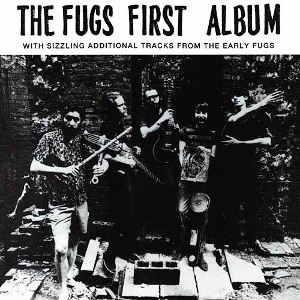
It’s not surprising that Gahr shot this album cover because he was there for the Fugs’ premiere at the grand opening of the Peace Eye bookstore on February 24, 1965. I’ll share photos Gahr shot of this event here. The photos show Sanders’ bookstore was packed on opening night, with old guard Beatniks alongside soon to rise hippies. Gahr’s photos document the counterculture percolating. Here is Sanders’ handbill for the event:

This handbill outlines the “total assault on the culture” that Fuck You/ A Magazine of the Arts declared. Every aspect of underground culture is represented here. The announcement for the third anniversary issue of Fuck You featuring a cover from Andy Warhol’s Couch shows literature and film overlapping. That Fuck You wasn’t a One Flew Over the Cuckoo’s Nest or Catch-22 is reflected in the handbill’s inclusion of porn as one of the things in the issue. The “World Premiere” of the Fugs adds music — and amphetamines — to this mix. Peace Eye was to be a new home base for the total assault on the culture.
The photo of Sanders talking with William S. Burroughs is the most important of these photos. This was a full-circle moment because Sanders’ total assault was inspired by Burroughs. In the photo, Sanders appears to be showing Burroughs the new Fuck You issue. Here we have Burroughs effectively endorsing Sanders’ project:
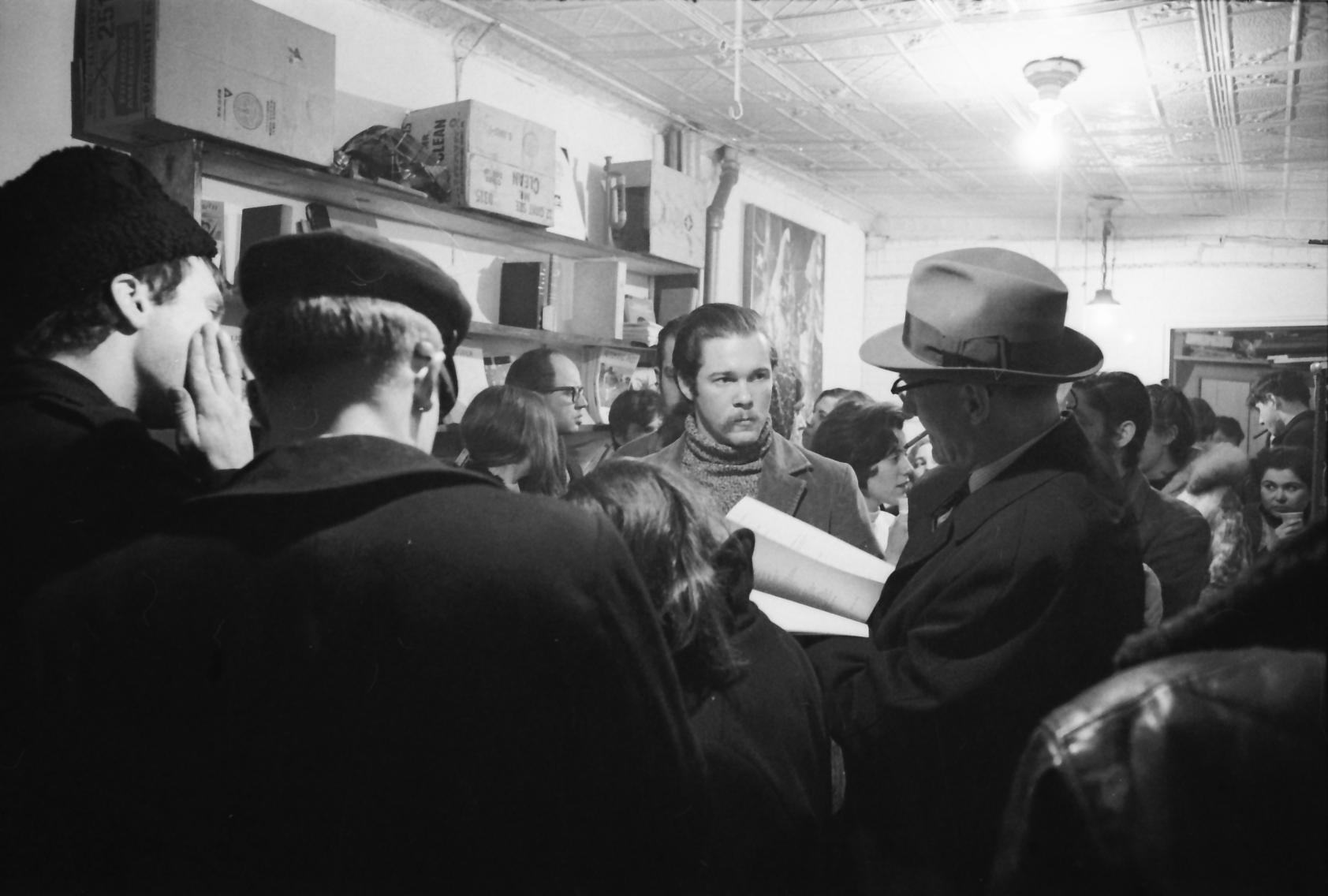
Burroughs had only just returned to the States, now with his recently gained reputation as an underground icon. His status within the underground at this moment can’t be overstated. Burroughs putting in an appearance made the opening.
Burroughs being there was bigger than Peace Eye opening, which is why Burroughs features prominently in Sanders’ 2011 memoir account while Burroughs’ biographies practically overlook this event. According to Sanders, Time sent reporters to cover the grand opening, and Burroughs expressed dislike for them, likely because of their coverage of his 1951 uxoricide. Ted Berrigan’s C Press published Burroughs’ response — his own version of Time — the same year Peace Eye opened. Peace Eye’s opening was big enough for Gahr to shoot and Time reporters to attend but not big enough for Time to run a story about. However, similar to Burroughs’ appearance, Time‘s attendance was important enough for Sanders to include in his memoir almost five decades later. Through his account of Burroughs and Time at the opening, Sanders positions himself as the bridge between the underground — represented by Burroughs — and the epitome of what the underground cast as its opposition — Time.
This wasn’t the beginning of Sanders’ involvement with Burroughs. Their relationship started with Sanders’ publication of Roosevelt After Inauguration in January 1964, which Jed Birmingham has written about. Sanders also published APO-33, which Birmingham has also written about. Additionally, not long after this event, Burroughs provided the motorcycle image on the cover of Fuck You‘s final issue.

Among the things this next photograph shows is the mimeo poetry world contributing to the rise of the underground press. While the underground press hadn’t begun when Sanders declared a total assault on the culture, Gahr’s photographs show the underground press incubating at Peace Eye.
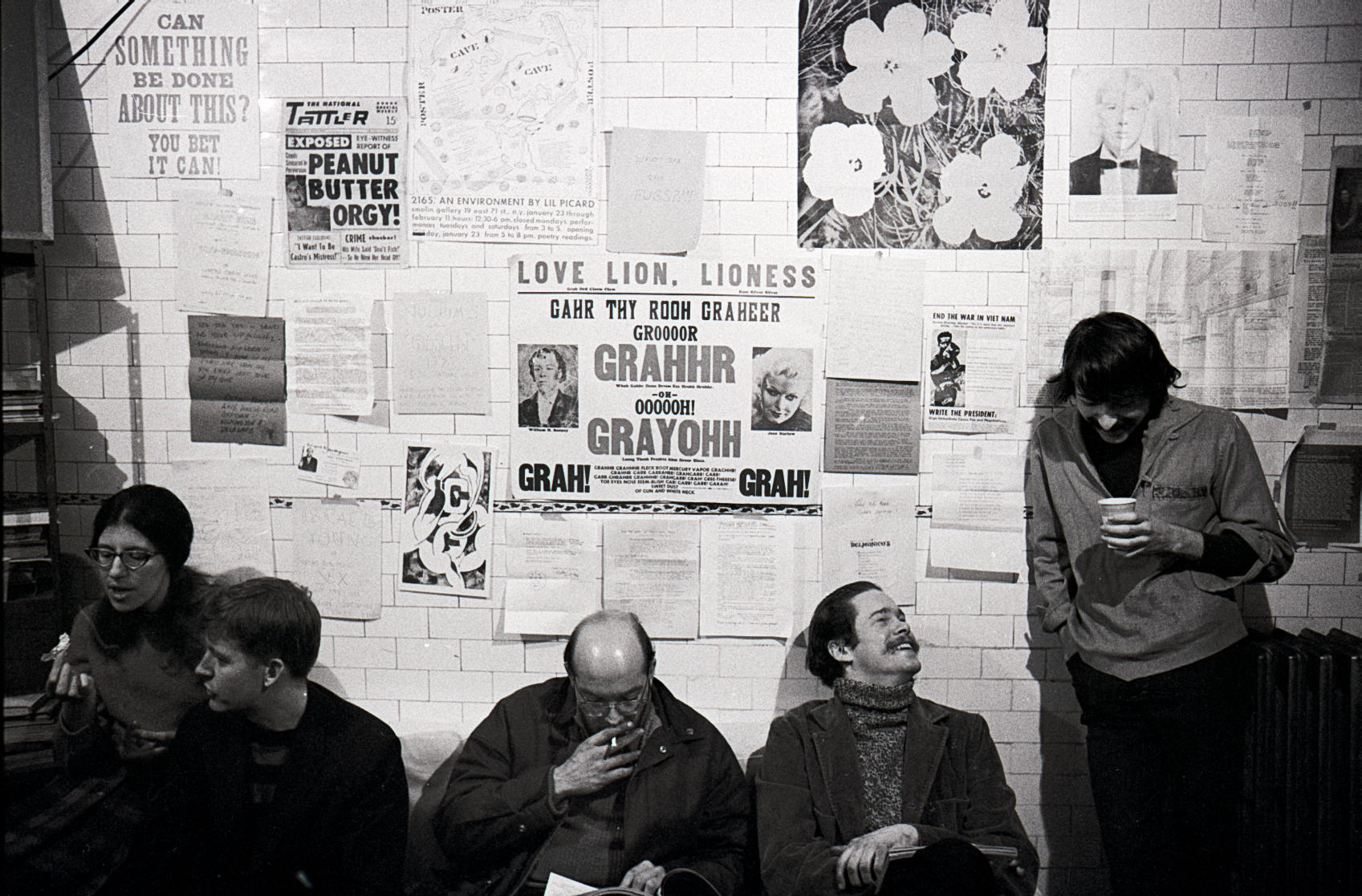
The balding man smoking next to Sanders at the center of the photo is Allen Katzman, co-founder of East Village Other (EVO), which would start later this same year. Alongside Paul Krassner’s The Realist and the Los Angeles Free Press, EVO was one of the most important underground papers of the Sixties. Sanders himself was offered an EVO ownership position but declined. Like Sanders, Katzman came out of the coffee house poetry scene, but Katzman writes in his unpublished memoir that he made a conscious decision to move away from poetry with the founding of EVO. The whole of historian Arthur Marwick’s “long sixties” (1958-1974) is in this photograph: EVO began as a standard newspaper, evolved in increasingly psychedelic directions, and by the late Sixties pivoted toward pornography with Kiss, helping lay the groundwork for the “porno chic” trend of the early 1970s. Fuck You was an inspiration for EVO.
There’s another through line in this photo to porno chic. On the left of the photograph is the National Tattler with the “PEANUT BUTTER ORGY” cover story. National Tattler was one of the sensationalist tabloids that Sanders, working at a cigar store on 42nd Street before opening Peace Eye, knew well. Fuck You editorials mimicked these tabloids. For this issue, Tattler editor Bob Luce photographed his naked wife covered in peanut butter melting under the hot lights. Pretty soft-core stuff, but this is also the kind of publication the reformed industrial spy turned pornographer Al Goldstein wrote for before starting Screw. Goldstein claimed Screw was a rebuke to the tabloids’ hypocritical embrace of graphic violence while shunning explicit sex. Goldstein inspired Larry Flynt, but it was Fuck You that inspired Goldstein. Not only did Sanders’ magazine give Goldstein the name Screw, but the “Fuck You” segment on his TV program Midnight Blue was lifted directly from the “bouquets of fuck yous” Sanders published — as was Flynt’s “Asshole of the Month” feature in Hustler. It’s been forgotten that before there was Larry Flynt, there was Ed Sanders.
Bob Luce eventually left the National Tattler to promote wrestling events around Chicago, which feels fitting with the Michael McClure poster above Katzman and Sanders. This “poster poem” riffed on boxing match promotions, eventually becoming the play The Beard, which faced various obscenity charges. The year after Peace Eye opened, Warhol shot a film version of The Beard. The significance of Peace Eye as a counterculture launching pad is reflected by McClure’s poster being on the wall well before the attention the play’s obscenity charges brought. Having the poster hung shows just how “in” a place Sanders’ scrounge lounge was.
Warhol wasn’t present for the grand opening — though Sanders says popular author James Michener came in a limousine on Warhol’s recommendation — but his presence was surely felt that night. Three Warhol flower silkscreens hung at the opening, one of which is visible above Sanders in the photo. To the right of the flowers appears to be a drawing of this photo booth self-portrait:
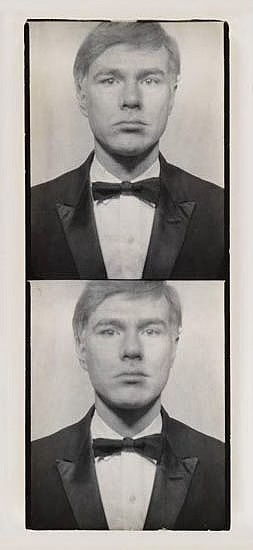
This photo booth self-portrait was of the bunch that Self-Portrait (Red) (1965) came from. Self-Portrait (Red) was at the center of the authentication debacle that Richard Dorment elaborates in Warhol After Warhol (2023). At minimum, Dorment shows how the Andy Warhol Art Authentication Board failed to account for Warhol’s use of distributed production methods. However, the Board’s actions — including reversing forgery rulings to sell works formerly rejected as authentic for millions of dollars — suggests motives more troubling than ignorance or oversight. Long story short, the Board spent over $7 million dollars to settle a lawsuit over one of these portraits, then disbanded after 16 years of operation, but in a way that sidestepped mounting legal and reputational danger by offloading authentication risk on buyers.
It’s possible that Sanders had his own run-in with the Andy Warhol Authentication Board, which operated from 1995-2012. Sanders reports having owned three silkscreened Warhol flower banners. One he destroyed in “a very expensive tear-up” for a Fugs show, another was abandoned in a deli, but the last he managed to keep long enough to christen “The Peace Eye Diptych” and sell. He doesn’t say how much he got for the banner or if he went through the board, only that he later saw it sell for $250,000. While Sanders bemoans the $500,000 he carelessly lost during the Sixties, back in 1965 making this kind of money probably wasn’t at the top of people’s minds. This likely changed by, say, 1967 — the year Sanders was featured on the cover of Life — with events like the Monterey Pop Festival proving the total assault on the culture’s mass appeal.
Sanders was no stranger to authentication controversy. The issue of Fuck You celebrated at Peace Eye’s opening included W.H. Auden’s poem about fellatio, “The Platonic Blow.” The poem had circulated underground for a while before Tram Combs of the Pierpont Morgan Library gave Sanders a version. At the time, some, such as Random House editor Jason Epstein, doubted that the poem was Auden’s. It was later learned that the poem really was Auden’s. Auden described this poem in this way: “Deciding that there ought to be one [pornographic poem] in the Auden Corpus, I am writing a purely pornographic poem, The Platonic Blow. You should do one on the other Major Act.” Sanders’ Bugger: An Anthology (1964) covered the other “Major Act” Auden jokes about.
In Fuck You, Sanders introduced “The Platonic Blow” as “a Gobble Poem snatched from the notebook of W.H. Auden,” thereby positioning his own Gobble Gang Poems in a literary lineage. The version printed in Fuck You swapped the first and fifth stanzas around, starting in medias res with:
He put down his glass and stretched his bare arms along
The back of my sofa. The afternoon sunlight struck
The blond hairs on the wrist near my head. His chin was strong,
His mouth sucky. I could hardly believe my luck.
Instead of:
It was a Spring day, a day, a day for a lay, when the air
Smelled like a locker-room, a day to blow or get blown;
Returning from lunch I turned my corner and there
On a near-by stop I saw him standing alone.
This error stands out from the kinds of anomalies typical of Fuck You (upside-down pages, mispagination, different kinds of paper, etc.), many of which may have been a consequence of the varied, unsupervised help Sanders had in collating issues. (See, for example, Andy Clifford’s description of putting together copies of Fuck You while crashing in the back of Peace Eye to hand out at the Bronx Zoo if Sanders was convicted). Tempting as it is to think this transposition could have been Berrigan-inspired, the stanza order’s correction in the subsequent Fuck You Press stand-alone edition suggests that the error was unintentional. (Fun fact: Guild Press published an illustrated version with photos of two men doing what the poem described in 1970.) Regardless, publishing a sexually explicit poem from a poet with Auden’s literary reputation — without his permission — was a big deal. Sanders’ commitment to “publish anything” brought together Pop Art and “serious” literature.
Underground filmmaking was another important part of the total assault on the culture, and Gahr documented Jonas Mekas, the God of American underground cinema at this time, attending the Peace Eye opening:
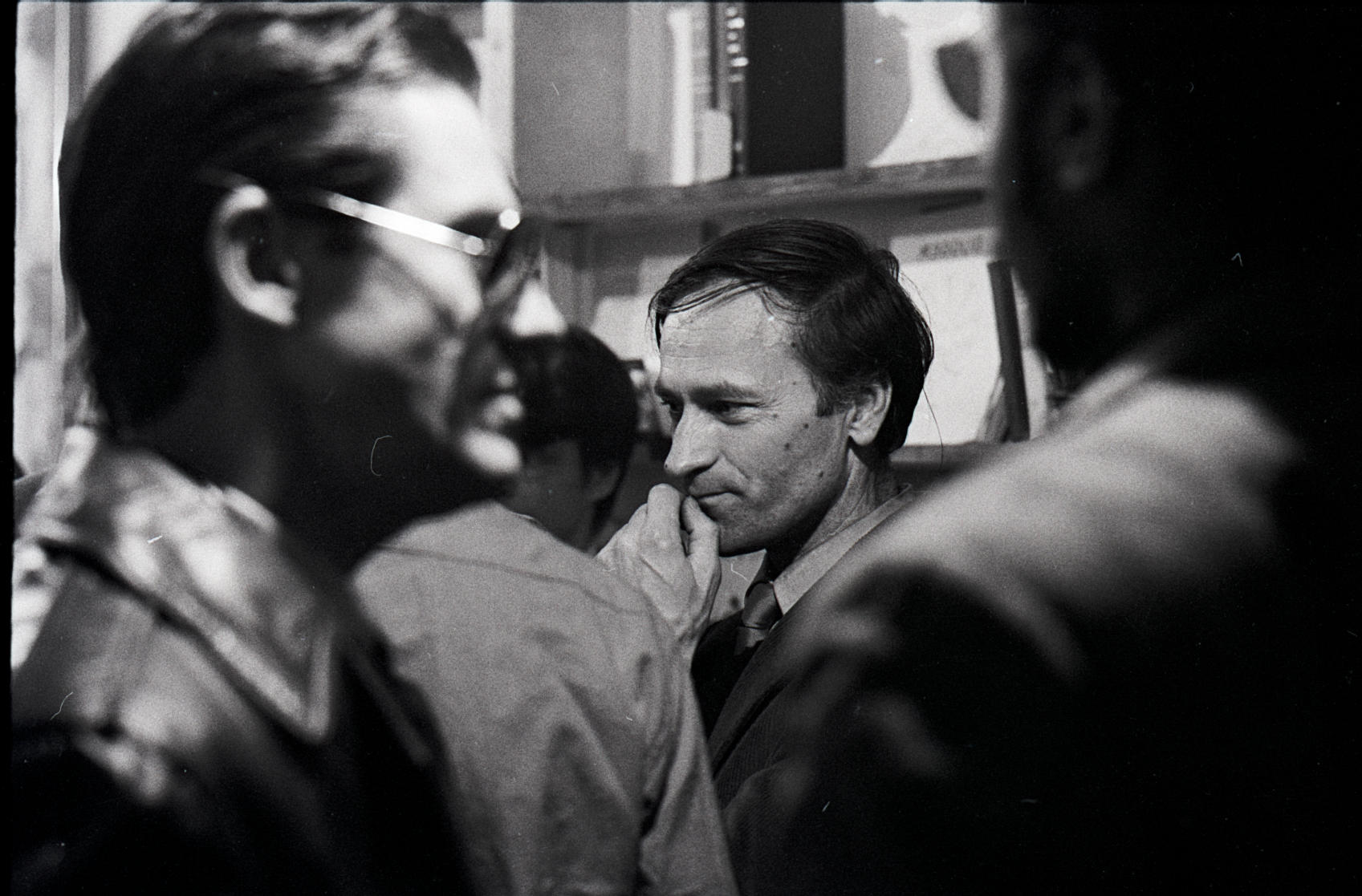
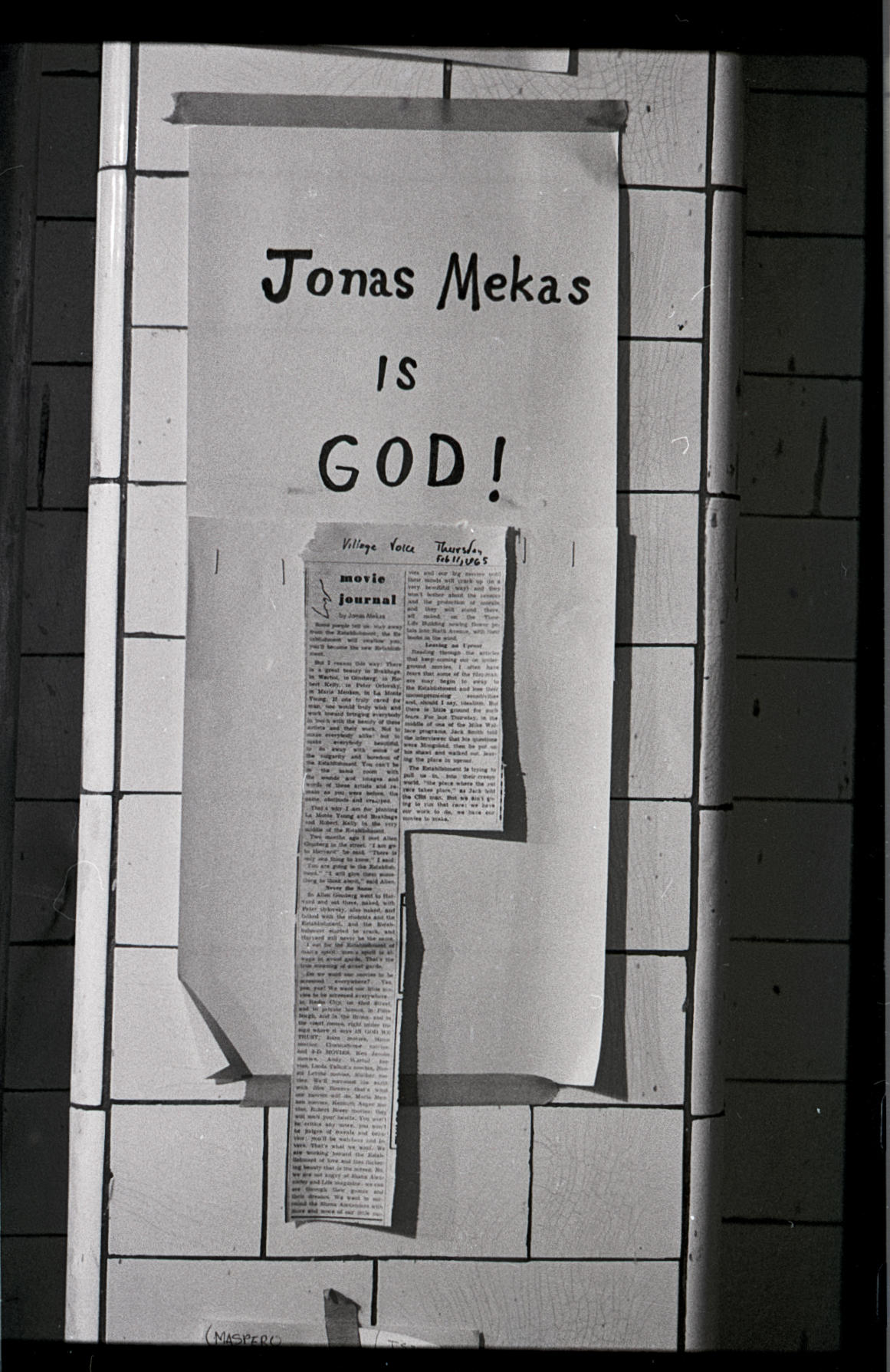
In addition to Burroughs, Mekas was a primary inspiration for Fuck You as well as Sanders’ brief stint as a filmmaker. Sanders has said that for years the first thing he read from the Village Voice was Mekas’ weekly column and that Mekas’ film Guns of the Trees inspired him to start publishing Fuck You. In fact, Fuck You‘s infamous dedication to those “groped by J. Edgar Hoover in the silent halls of congress” comes from a poem Allen Ginsberg reads in Mekas’ Guns of the Trees. Mekas sourced cheap blackmarket film, possibly from the air force, and a discreet development service for Sanders. He also funded Jack Smith’s film Flaming Creatures, which figured in Sanders’ 1967 obscenity trial. Here is a shot of a Village Voice clipping with Sanders’ pronouncement that Mekas is God on the wall of Peace Eye that Gahr photographed:
One last component of the total assault on the culture that I want to show from these photographs are the Fugs. The Fugs were proto-punk, and the FBI famously called them “the filthiest and most vulgar thing the human mind could possibly conceive.” The FBI is probably overselling it, but their shows were much more wild — in the spirit of happenings — than they tend to be described now. Keep in mind that Sanders was still very much in Warhol’s orbit at this point. I wish I had the contact sheets or negatives from the Fugs’ album cover shoot, but I’ve lost bid after bid on Fugs items, usually in the last 10 seconds of the auctions. If an eBay sniper is reading this, in the spirit of Sanders I say, fuck you. RealityStudio readers will have to settle for photos of Fugs at the opening event. Here Tuli Kupferberg is reading in the front right of the frame, and Peter Stampfel — who joined the Fugs from The Holy Modal Rounders — is talking with Katzman at the center:
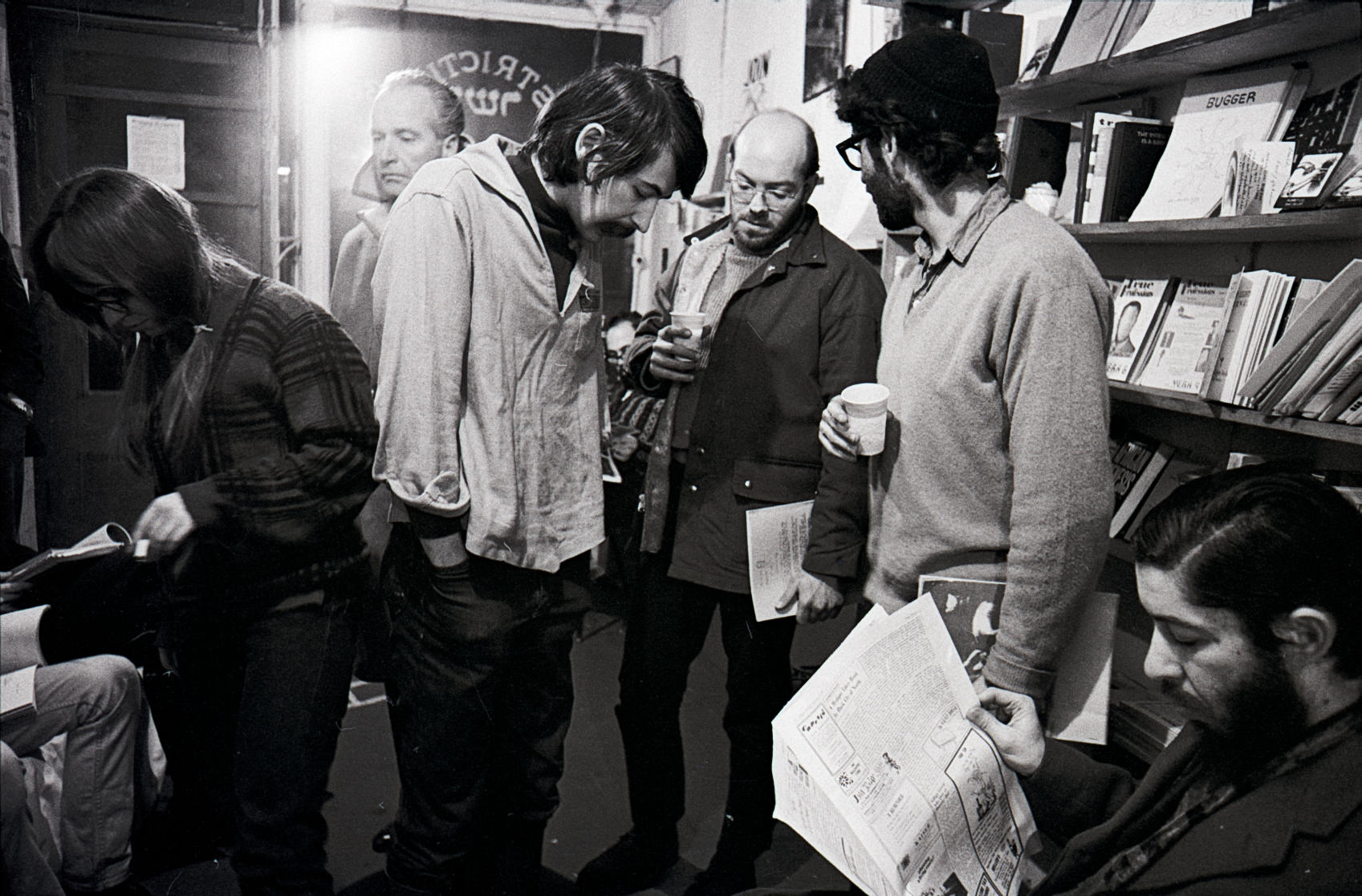
There’s a copy of Bugger on the shelf behind them, and Kupferberg appears to be reading the Village Voice. I can’t make out the full title of the magazine behind the individual between Kupferberg and Katzman (does anyone recognize him? Peter Orlovsky?), but the first word of the magazine’s title appears to be “true” (True Confessions? True Detective?). This person I can’t name appears to be holding a copy of the new Fuck You issue. I didn’t see Fug Steve Weber in any of these photographs but I believe Ken Weaver is in the sweater (balding, with glasses) in the center of this final photo:
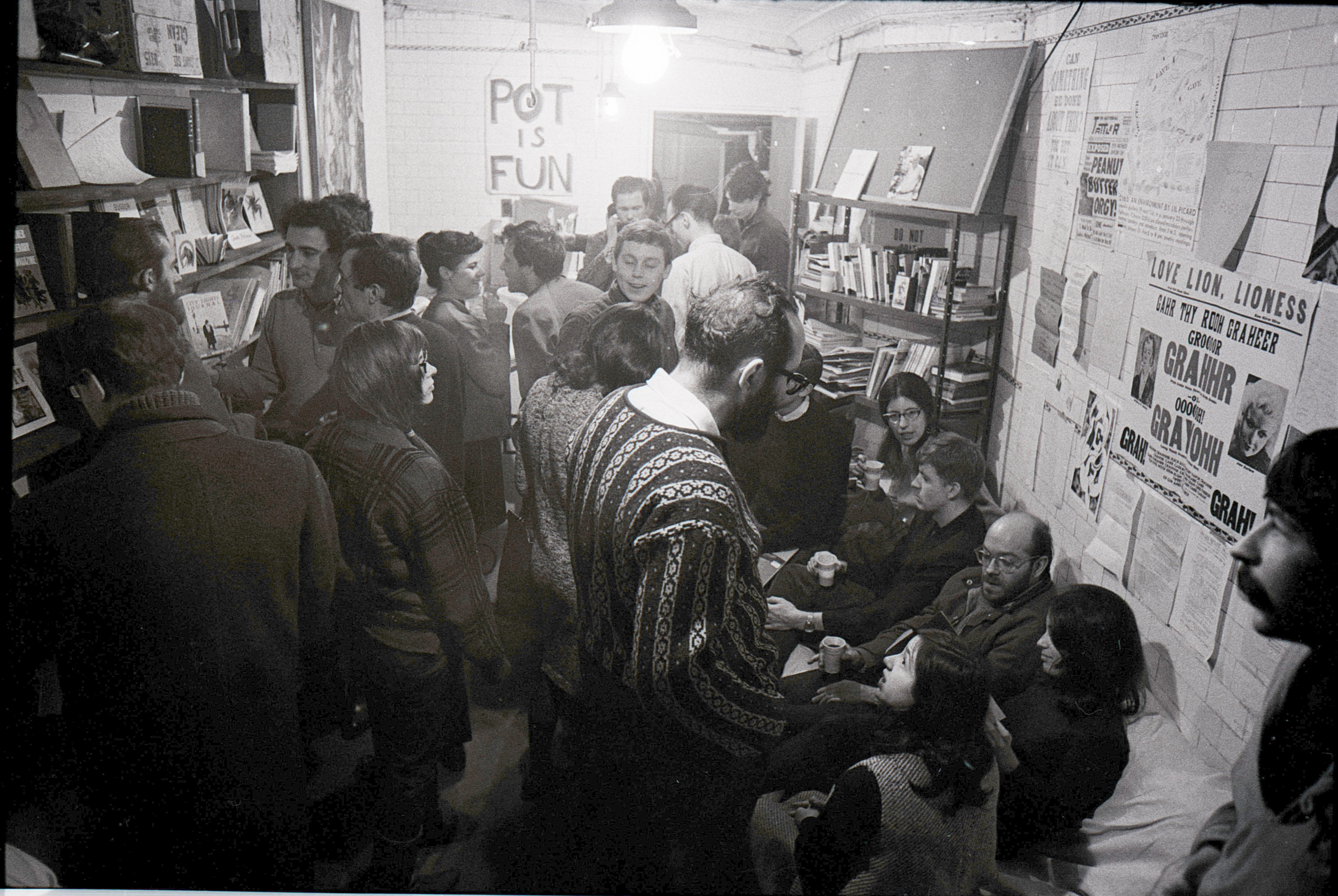
You can also see Stampfel in the right corner and Katzman on the couch. The infamous “pot is fun” sign is visible in the back. Peace Eye, it’s worth recalling, was also home to the Marijuana Review, an important organ of the total assault on the culture. As a flip through the pages of Fuck You will show, drugs were an integral part of this cultural assault. Rumor has it that Thurston Moore has this “pot is fun” sign (and maybe some rare Fuck You Press items to boot). If anyone reading this can put me in touch with Moore, I’d love to talk.
Gahr’s photographs capture the counterculture on the verge of becoming The Counterculture. The Peace Eye that appears here is at a crossroads where poetry, underground film, folk music, obscenity battles, experimental publishing, pornography, psychedelic journalism, and avant-garde art all occupied the same physical and social space. Burroughs, Mekas, Warhol, Katzman, the Fugs, and Sanders each represent developments that would later tend to be remembered as distinct histories. Here we can see them — and many I can’t identify — existing within a single milieu. The total assault on the culture that Sanders proclaimed was less a coherent program than a network of overlapping projects, personalities, and ambitions that hadn’t yet settled. These photos are a reminder of how much was incubated in places that at the time seemed temporary and marginal. Many of the developments traced through these photos eventually became industries and institutions. It’s tempting to see Peace Eye as the beginning of an inevitable story but Gahr’s photos can be read differently: a crowded room full of people who had little idea what would matter fifty years later. That uncertainty is what makes these photos valuable.