by Jed Birmingham
Where do you begin with the tidbits that lurk within?
A: Is anything really trivial in an archive? That seemingly innocuous scrap of paper may be the missing piece that completes the puzzle that is your research project. Or maybe it just supplies a narrative or factoid that adds some life to a paragraph within? Or most likely it doesn’t quite fit in your project at all, but it is too interesting to let go of completely, so it makes a spicy footnote that gives your research project flavor. The Sanders Archive is full of seemingly trivial like this.
B: One of the most endearing things about the Fugs is that they could not really play. In that respect the band is a merging of garage and folk before the lo-fi movement of the likes of Jeffrey Lewis. There is quite a bit of “Louie, Louie” in “Boobs-a-Lot.” Even better the Fugs were proto-punk. Their lack of virtuosity is what makes them influential. “This is a chord, this is another, this is a third. Now form a band.” This is the DIY idea at its finest. The Fugs fit in perfectly with the Fuck You Press aesthetic, which gives off an air that anybody can do this shit: from the printing, to the design, to the poems themselves. All you have to do is get started. And maybe take some speed. A lot of speed. Sid Vicious could have been a Fug precisely because he could not play, which makes the contents of the following folder in the Sanders Archive so weird and fascinating.
C: On Record Store Day for Black Friday 2025, I bought an LP of The Eleventh House featuring Larry Coryell live at the Riviera from 1976. In recent years, YouTube music commentators have gotten me into jazz fusion, especially fusion guitar. Jimi Hendrix and the Band of Gypsies live album probably prepared my ears for fusion. John McLaughlin is considered the Jimi Hendrix of the genre, but Jeff Beck might be the Miles Davis of the electric guitar. Beck, like Miles, constantly evolved on his instrument and never stayed put in one style. Many talk about Allan Holdsworth and I am still looking for the Soft Machine albums he performed on. The consensus is he is a giant. I have a soft spot for Tommy Bolin. He made The James Gang and Deep Purple relevant after the devastating departures of Joe Walsh and Ritchie Blackmore from those respective bands. Bolin played some mean fusion as well. But my favorite is Larry Coryell, the Godfather of Fusion. He was an OG and to my ears he does it the best. So, it was music to my ears to see Coryell in the Sanders Archive even if it was only just a few notes.
Where to begin with Box 307, Folder: Tryouts for Fugs Fall 65. If you look in the Sanders Finding Aid, you are not going to find any mention of this folder. Proof that the Finding Aid is incomplete and maddening when you realize that any of the 400-plus boxes in the Archive might have just the thing you were looking for. As it happens, the folder above contained just the type of thing I was looking for.
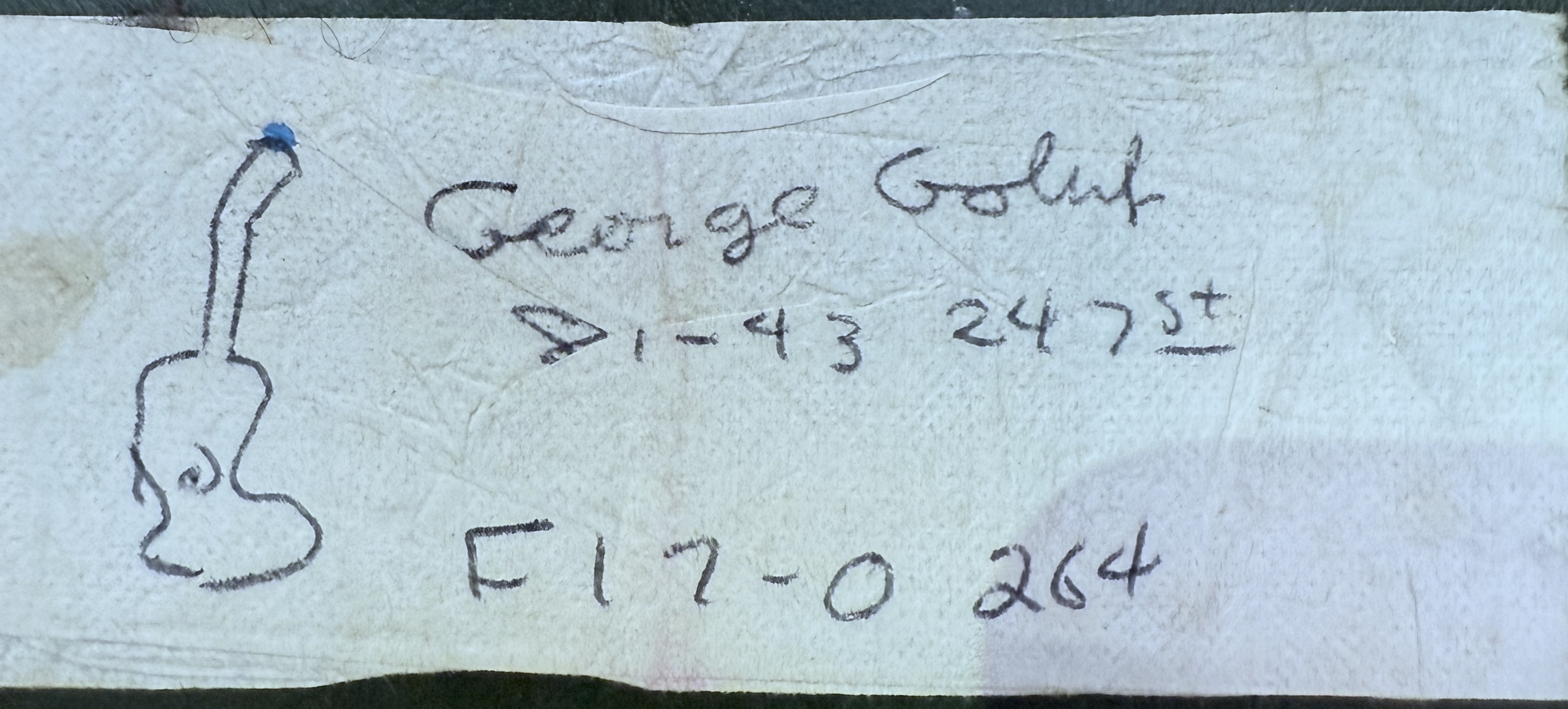
In the folder were two scraps of paper. The first I saw was the name, address, and phone number of George Golub at 81-43 247st, F17-0264, with a drawing of a guitar to the left. There is a Jeff Golub, a jazz guitarist, and a Gregory Golub, a jazz pianist, associated with music. Not what I was looking for. But close. I was able to find a brief biography of a George Golub, who was associated with the East West Musical Instruments Company in San Francisco, which operated from 1967 to 1979. Pretty cool piece of trivia. Interesting but not earth shattering.
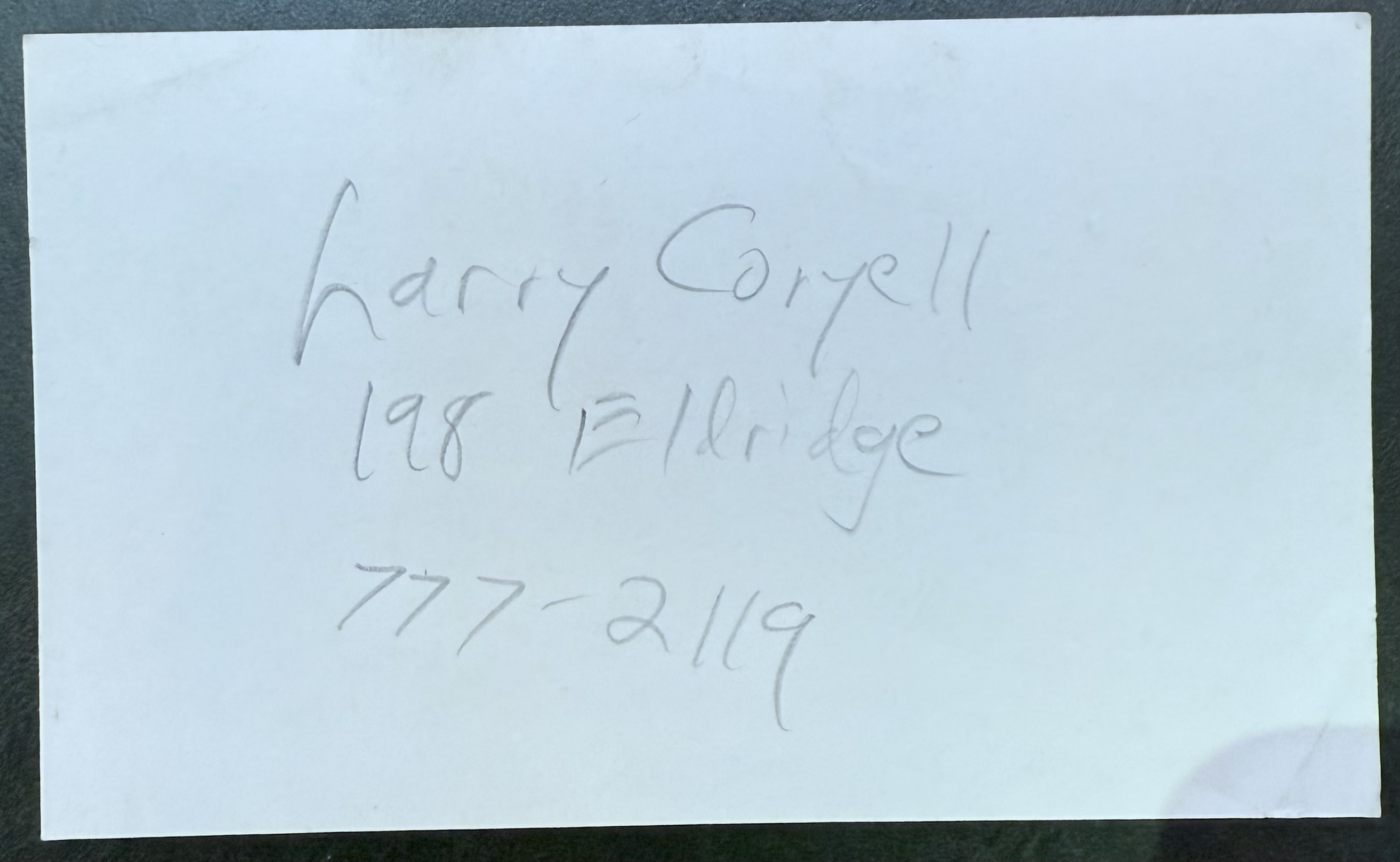
These were interesting threads to pursue until I looked at the second scrap of paper in the folder: Larry Coryell, 198 Eldridge, 777-2119. What the fuck? The thought of a guitar god like Larry Coryell in the Fugs, I must admit, blew my mind. Here is Nat Finkelstein from Uptight on Fugs musicianship: “One of the reasons I got tossed out of that whole Lower East Side group was the fact that I was working with The Velvets. Also Lou and John were pretty good musicians, whereas Ed Sanders and Tuli Kupferberg wouldn’t have known music if it’d bit them on the ass.”
Coryell wrote a book, Improvising: My Life in Music, and there is quite a bit of name dropping in there, but he never mentions the Fugs or Ed Sanders at all. Coryell writes about being in New York City in the 1960s but this moment, from Fall 1965, must have been inconsequential for him. It is fun to fantasize about what Coryell played at that audition. Did he just sit in with the Fugs and jam? It would have taken him a few seconds to learn the rudimentary guitar work of the Fugs. Did Coryell show Sanders and the boys the full extent of what he could do?
What would the Fugs have become if Coryell had joined the band? Would they have become some type of jam band with poetry? Or a true rock band? Or one of the first protofusion outfits with crazy, juvenile lyrics like “Slum Goddess from the Lower East Side” as opposed to the Eastern mysticism bullshit that dominates so much fusion of the 1970s.
Coryell moved to New York City in September 1965, attending Mannes School of Music. The Fugs audition must have been one of the first tryouts he attempted in the Big Apple. Eventually, Coryell hooked up with Chico Hamilton’s quintet, replacing guitarist Gabor Szabo. So clearly by the time Coryell arrived in New York City in September 1965, he was already a brilliant jazz guitarist, if unknown. In terms of technique and virtuosity, this is quite a distance from the Fugs. Coryell would not see Jimi Hendrix live until 1967 in Manhattan at The Scene. In 1969, he was invited to join Tony Williams’ Lifetime, which he declined. He suggested that John McLaughlin would be ideal for the job. He was. From an early age, Coryell was a monster musician. Why would he slum around with the Fugs? Were the Fugs actually paying anything? Apparently not.
This is perfect footnote stuff if you are researching a book on the Fugs or Coryell. Sanders lays it out in Fug You and answers some of the questions above:
A Police Informant Trying Out for The Fugs
Meanwhile I ran an ad in the Village Voice looking for a guitarist or a bass player to accompany us on the cross-country tour. I interviewed four. The first was Larry Coryell, not yet famous, with a very expensive guitar; we couldn’t afford him. The second was underage, so I turned him down.
The third turned out to be a police informant. I know this because George Plimpton called me at Peace Eye and told me that a famous crime reporter had brought to a party a police informant who had just tried out for The Fugs! Good thing I hadn’t been that impressed with the way he played the guitar.
The fourth one, whom I hired, was named Jon Sheldon, who later became a doctor
Hmmm. Who was George Golub? I guess I will leave that one alone. Too hot to handle. Maybe a future researcher will dig around and fill out this footnote. The results will make for interesting reading.